.gif)
Nature
Published online:
01 September 2004; | doi:10.1038/431014a
Physics and music: Brothers in artSarah Tomlin
Sarah Tomlin edits News Features for Nature
from New York.
Piers Coleman
is a theoretical physicist, his brother Jaz a musician with an
unusual pedigree. Together, they want to break down boundaries
between science and the arts. Sarah Tomlin attends their
latest concert.
|
|
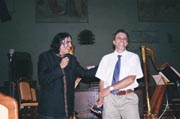
Renaissance men: Jaz (left) and
Piers Coleman at the European premier of Music
of the Quantum. A. HAVLICKOVA/CMD20
SECRETARIAT | | On almost every street corner in
Prague, someone is handing out flyers for a concert in one of
the city's historic churches. In one, it's a recital of
Mozart; in another, Vivaldi. But on this balmy July evening, I
join a crowd of physicists at the Bethlehem Chapel who have
come to hear something less familiar: music by a contemporary
composer, whose muse tonight is the science of quantum
matter.
First, we are treated to a lecture
by Tony Leggett of the University of Illinois at
Urbana-Champaign, who shared the 2003 physics Nobel for his
theories on the behaviour of superfluid helium-3. Then the
overhead projector is removed to make way for two harps, a
double bass, violin and accordion. A quintet of young Czech
musicians takes to the stage. Against a painted backdrop of
musical scores from the fifteenth century, melodies from the
violin and accordion intertwine to create Music of the
Quantum.
The concert is the brainchild of
the brothers Coleman — one clad tonight in a short-sleeved
shirt and tie, the other in a long black jacket over jeans and
sandals. The sober-looking Piers is a theoretical physicist at
Rutgers University in New Jersey. At 46, he is the elder by
two years, but looks more boyish than his bohemian brother.
Jeremy 'Jaz' Coleman is composer-in-residence with the Prague
Symphony Orchestra. But to many fans, he is better known as
leader of the experimental rock group Killing Joke, formed in
1979 from the embers of the British punk scene.
Music of the Quantum was commissioned by the
Institute for Complex Adaptive Matter, a network of
researchers that aims to advance condensed-matter science (see
'Small science thinks big',
overleaf). It premiered in 2003 at Columbia University in New
York, on the weekend that the United States invaded Iraq. This
resulted in a disappointing attendance, as most New Yorkers
remained glued to their TV sets.
The brothers are
hoping for a more enthusiastic reception in the Czech capital,
where the music was composed. Earlier in the day, in a
wide-ranging discussion over lunch in Prague's old quarter,
they talk about their motivations. "Whether it is science or
art, the idea is to make the world a more beautiful place,"
says Jaz. For Piers, the ultimate goal is to communicate ideas
about physics to a wider public. "Scientists have a duty to
explain to those who are footing the bill what makes our
hearts beat faster," he says.
*Text above
is to be translated*
 Scientists have a duty to explain
to those who are footing the bill what makes our
hearts beat faster. Scientists have a duty to explain
to those who are footing the bill what makes our
hearts beat faster.  | | |
 |
| The da Vinci road
The brothers'
respective interests took them down separate paths from an
early age. "This is the first time we've done anything
together since we were kids," says Piers. They both recall a
happy childhood in Cheltenham, UK, nurtured by an English
father and a half-Bengali mother — both of them teachers — who
encouraged the boys to aspire to Leonardo da Vinci's
Renaissance thinking.
|
|
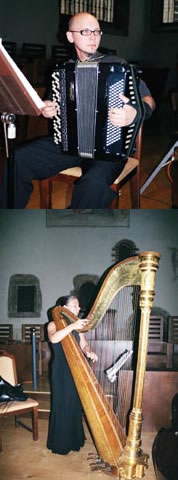
Concerted effort: Tomas Damec
(above) and Veronika Vachalova wrestle with
physics. D.
PARKER/IMI/A. HAVLICKOVA/CMD20
SECRETARIAT | | For Jaz, school proved a less
harmonious environment. He was bullied because of his
mixed-race background, but reckons that these hard knocks have
served him well. "My father always said it was good training
for the music industry," he says. Jaz gave up on conventional
schooling at 14, and three years later formed Killing
Joke.
While Piers studied physics at the University of
Cambridge and then at Princeton University in New Jersey, Jaz
lived the stateless existence of a touring rock musician.
Listening to Killing Joke has always been an intense
experience — 'doom-laden' is a common description of their
heavy, rhythmic sound — and Jaz soon acquired a reputation for
eccentric behaviour. In 1982, he suddenly disappeared to
Iceland, fearing an imminent apocalypse.
The
conflagration never came, and over the subsequent years, Jaz
has done his best to live up to his parents' Renaissance
ideals. In 2003, Killing Joke released a critically acclaimed
eleventh studio album. In parallel, Jaz has built a career as
a classical composer. He delights in crossing boundaries,
whether composing contemporary music for Maori singers and
Czech folk groups or collaborating with Vanessa-Mae on a
Disney film soundtrack. He has recorded with artists as
diverse as Sarah Brightman and Mick Jagger, and is now working
on his second opera.
Piers' career has been more
conventional, even though he would love to be able to jump
between scientific disciplines in the same way that Jaz leaps
from one musical genre to another. "I'd like to think it is
possible," Piers says — but concedes that the specialization
required of today's scientists makes this an unlikely dream.
In tutoring his students, however, Piers tries to encourage a
broader outlook, telling them that "equations are like
haiku", with their own poetic beauty.
For
Piers, the collaboration with his brother represents an
unusual opportunity to meld science and art. He first got Jaz
interested in physics by sending him The Dancing Wu Li
Masters, a 1979 book by Gary Zukav that sought to engage
the public with theoretical physics by drawing parallels with
Eastern philosophy.
The impossible
dream
In keeping with this introduction,
Jaz has a spiritual approach to science, and is drawn to
outlandish ideas. He is fascinated, for instance, by anything
to do with antigravity. "As you can see, we have great
discussions," says Piers, laughing. He has told Jaz that
antigravity cannot exist, but argues that what science can do
— levitating a magnet above a superconductor, for instance, as
he shows in a movie during the concert — is just as wonderful.
"If you want to do great science, or great art, you need a
dream of what is possible," Piers concludes.
Aside
from a chance to collaborate with his brother, Jaz was
attracted by the ambitious brief that Piers gave him. Each of
the composition's three movements tries to embody different
concepts: emergence and broken symmetry, phase transformation
and criticality, and the duality of the quantum
world.
Criticality is a tough concept to explain in words,
let alone music. Physicists know that new forms of order can
develop within matter through phase transformations, which
drastically change the material's properties. Examples include
the emergence of magnetism or superconductivity at certain
temperatures. Matter that is close to such a transformation is
said to be in a critical state, and Piers wanted the movement
to convey its dynamic behaviour.
"I am forever trying
to understand my brother and his work," says Jaz. "I'm a
musician and composer, so I love numbers." But when it comes
to theoretical physics, Jaz admits that Piers might as well be
speaking Chinese. So they communicate in visual terms. For the
final movement on quantum duality, Piers wanted a piece from
which the listener can either hear two things at once, or by
listening carefully just one or the other. So he urged Jaz to
create the musical equivalent of an Escher drawing.
Given
his own dual musical existence, Jaz may be the ideal composer
to write about the quantum world. For him, the rock band is a
collective, visceral experience, whereas the life of a
classical composer is solitary and cerebral. Killing Joke is
about getting "the anger and sickness out of me", he says. But
when it comes to his classical compositions, Jaz is a romantic
purist, stressing melody above all else.
Jaz
also divides his time between contrasting environments. He
spends half the year in Europe, immersed in the cultural
intensity of Prague, retreating to a remote island off the
coast of New Zealand for the remainder. There he is building a
house of his own design, which will be powered by renewable
energy.
Raising the bar
In
writing Music of the Quantum, both Jaz and Piers wanted
to engage non-physicists with the beauty of its underlying
scientific concepts. "The idea of these concerts is to
inspire, to make people think in different ways," says
Jaz.
| The idea of these concerts is to
inspire, to make people think in different
ways. | | |
|
| But the two performances can't claim to have achieved
great outreach. Half of the audience in New York were
scientists, the rest what Jaz calls "science groupies". And
owing to restrictions surrounding the use of the venue, the
Prague event is not open to the public. Instead, it has been
organized as a cultural evening for those attending a meeting
on condensed matter, hosted by the European Physical
Society.
Piers is disappointed, but hopes
that his example will inspire other condensed-matter
physicists to reach out to a wider public. "It's a
controversial issue," he says — some of his colleagues believe
that the beauty of science should emerge naturally from the
work, and doesn't need to be packaged for a wider audience.
"How élitist," Jaz observes.
|
|
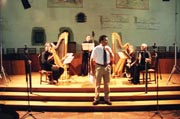
Take note: Piers Coleman
discusses the physics concepts that inspired the
music. A.
HAVLICKOVA/CMD20
SECRETARIAT | | In the Bethlehem Chapel, Piers
introduces each movement with a brief lecture on some of the
physics concepts that inspired the work, leaving the audience
with a final thought or image — a snowflake to represent
broken symmetry, for instance.
Jaz is up next. He's
a very physical conductor, often moving his whole body,
whipping round his shoulder-length hair, with the music. "The
three movements are essentially dances," he
explains.
Music of the Quantum is
uplifting, and the musicians are clearly talented. Piers'
talks before each movement are refreshingly wide-ranging and
entertaining. Some physicists might baulk at the reincarnation
of Schrödinger's cat as the cartoon character Garfield, but
Piers says that his 14-year-old son loved it.
Are the
physical concepts successfully expressed within the harmony?
I'm not entirely convinced, so I seek the views of scientists
with a musical bent in the audience. Michelle Prevot, a
chemist from the Max Plank Institute of Colloids and
Interfaces in Potsdam, Germany, plays the clarinet and flute.
She was impressed by the skill of the musicians and intrigued
by the unconventional nature of the quintet — using the
contrasting sounds of a violin and accordion to carry
overlapping melodies. But Bedrich Velicky, a theorist at
Charles University in Prague, and also an amateur musician,
felt that the three movements failed to reflect the depth of
the concepts involved.
Perhaps physicists are too close to
the subject matter — the music was composed for a wider
public, after all. And Piers hopes that this goal won't be
lost forever. There are plans for a CD and a website, which
will include sound and film clips from the concerts, along
with interactive quantum experiments and soundbites from
interviews conducted with audience members from the New York
performance.
The website should be finished by
early autumn, but that will depend on the brothers' other
commitments. "In parallel with this, serious physics is going
on in my life, and serious music is going on in Jaz's," he
says.
For his part, Jaz seems happy to be kept busy.
"There's no slowing down in our family," he says. It's about
"hurtling to the grave, grinning as we go".
|







.gif)
